
Off-Page SEO
Importance, Factors, and Techniques
Off-page SEO refers to strategies used outside your website to improve its authority, credibility, and search engine rankings. These external signals help search engines evaluate how trustworthy and relevant your website is compared to competitors.
Off-page search engine optimization includes techniques such as link building, digital PR, content marketing, local SEO, brand building, and brand mentions. These strategies help strengthen your website’s online presence and create a solid foundation for higher search visibility and organic traffic growth.
What Is Off-Page SEO?
Off-page SEO, also known as off-site SEO, refers to all optimization activities performed outside your website to improve search engine rankings, authority, and online visibility. While on-page SEO focuses on optimizing elements within your website, off-page SEO focuses on building external trust signals that show search engines your website is valuable and credible.
The primary goal of off-page SEO is to demonstrate to search engines that your website provides reliable and useful content. When authoritative websites link to your content, search engines interpret these backlinks as votes of confidence, signaling that your information is trustworthy.
However, in off-page SEO, quality matters more than quantity. A single backlink from a highly authoritative website can have a greater impact on rankings than dozens of links from low-quality or irrelevant sources.
The main components of off-page search engine optimization include:
-
Link building strategies
-
Digital PR campaigns
-
Content marketing
-
Local SEO optimization
-
Brand building and brand mentions
Together, these strategies help build a strong foundation for search visibility, authority, and organic traffic growth.
Off-Page SEO Ranking Factors
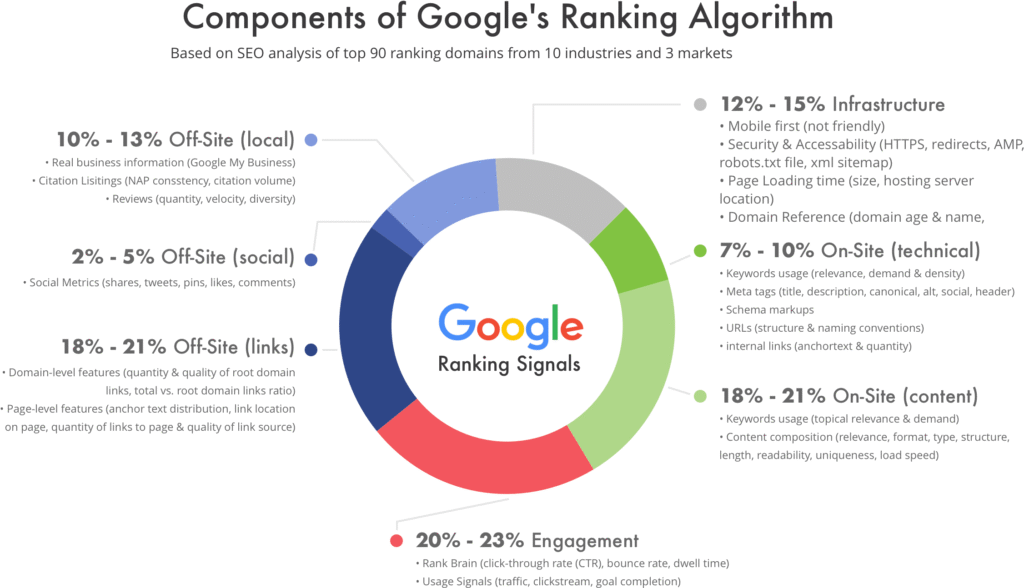
Off-Page SEO Ranking Factors
Off-page SEO ranking factors determine how search engines evaluate a website’s authority, credibility, and relevance based on external signals. These factors influence how Google and other search engines perceive your website’s reputation and trustworthiness compared to competing websites.
Understanding and optimizing these off-page SEO ranking factors helps build a strong foundation for long-term search visibility and organic growth.
Search engines use complex algorithms to analyze external signals such as backlinks, brand mentions, and user engagement. These algorithms evaluate factors like link quality, link relevance, referring domains, and natural growth patterns. Recent updates to search algorithms have placed greater importance on contextual relevance and high-quality backlinks rather than simply the number of links.
Websites that rank highly in search results typically have diverse and authoritative off-page signals from multiple trusted sources.
Key Off-Page SEO Ranking Factors
Number of Referring Domains
The number of referring domains represents how many unique websites link to your site. Search engines view links from multiple domains as independent votes of confidence. The more high-quality websites linking to your content, the stronger your website’s perceived authority.
Link Authority
Link authority measures the strength and credibility of the websites linking to your content. Links from high-authority websites carry more weight than links from smaller or low-quality websites. Metrics such as Domain Authority (DA) or Domain Power (DP) are commonly used to evaluate link strength and prioritize link-building opportunities.
Link Relevance
Link relevance refers to how closely related the linking website’s topic is to your website’s content. Backlinks from websites in the same industry or niche are more valuable than unrelated links. Search engines evaluate relevance at several levels, including website relevance, page relevance, and contextual relevance within the linking content.
Anchor Text
Anchor text is the clickable text used in hyperlinks that point to your website. It helps search engines understand the topic and context of your page. A natural anchor text profile includes a mix of branded anchors, partial keyword anchors, exact-match keywords, naked URLs, and generic anchors like “learn more” or “click here.”
Customer Reviews
Customer reviews are another important off-page ranking signal, especially for local SEO. Positive reviews on platforms such as Google Business Profile, Yelp, and industry directories strengthen your brand credibility and influence how search engines evaluate your business reputation.
How to Do Off-Page SEO
A successful off-page SEO strategy requires a structured and strategic approach that builds high-quality external signals while avoiding tactics that could trigger search engine penalties.
Effective off-page SEO combines several techniques to create a natural and diverse profile of backlinks, mentions, and authority signals that strengthen your website’s reputation.
1. Define Your Off-Page SEO Goals
Before launching an off-page SEO campaign, define clear and measurable objectives that align with your overall business goals. These goals could include increasing organic traffic, generating more leads, improving keyword rankings, or building brand authority.
Setting clear objectives ensures your off-page efforts focus on real business outcomes rather than vanity metrics.
2. Conduct an Off-Page SEO Audit
An off-page SEO audit helps evaluate your current backlink profile, brand mentions, and overall external signals. This process identifies strengths, weaknesses, and opportunities for improvement.
An audit also establishes a baseline to measure the effectiveness of future SEO efforts.
3. Launch Off-Page SEO Campaigns
Once your objectives and audit insights are clear, start implementing targeted off-page SEO campaigns. These may include link building, digital PR, guest posting, influencer outreach, and content promotion.
A balanced strategy should combine short-term opportunities with long-term relationship building with trusted websites and industry publications.
4. Track and Measure SEO Performance
Monitoring your results is essential for improving your SEO strategy. Track metrics such as backlinks gained, keyword rankings, organic traffic, referral traffic, and conversions.
Tools like Google Analytics, Google Search Console, and professional SEO platforms help you analyze performance and make data-driven improvements to your off-page strategy.
Boost Your Rankings with Powerful Off-Page SEO
Off-page SEO is essential for building website authority, trust, and higher search rankings. By earning high-quality backlinks, brand mentions, and external signals, search engines recognize your website as credible and relevant.
At Dreams Unlimited, we use proven off-page SEO strategies including ethical link building, digital PR, guest blogging, and content promotion to strengthen your online presence and drive sustainable organic growth.
Our approach focuses on quality backlinks, strong brand signals, and long-term SEO success, helping your website rank higher for competitive keywords.
Ready to Strengthen Your Website Authority?
Let our SEO experts build a powerful off-page SEO strategy that drives more traffic, visibility, and leads for your business.
Get Your Free SEO Consultation Today →
Get Your Free SEO Consultation Today →