
What is TAM, SAM and SOM
Not sure if your market slide passes the test?
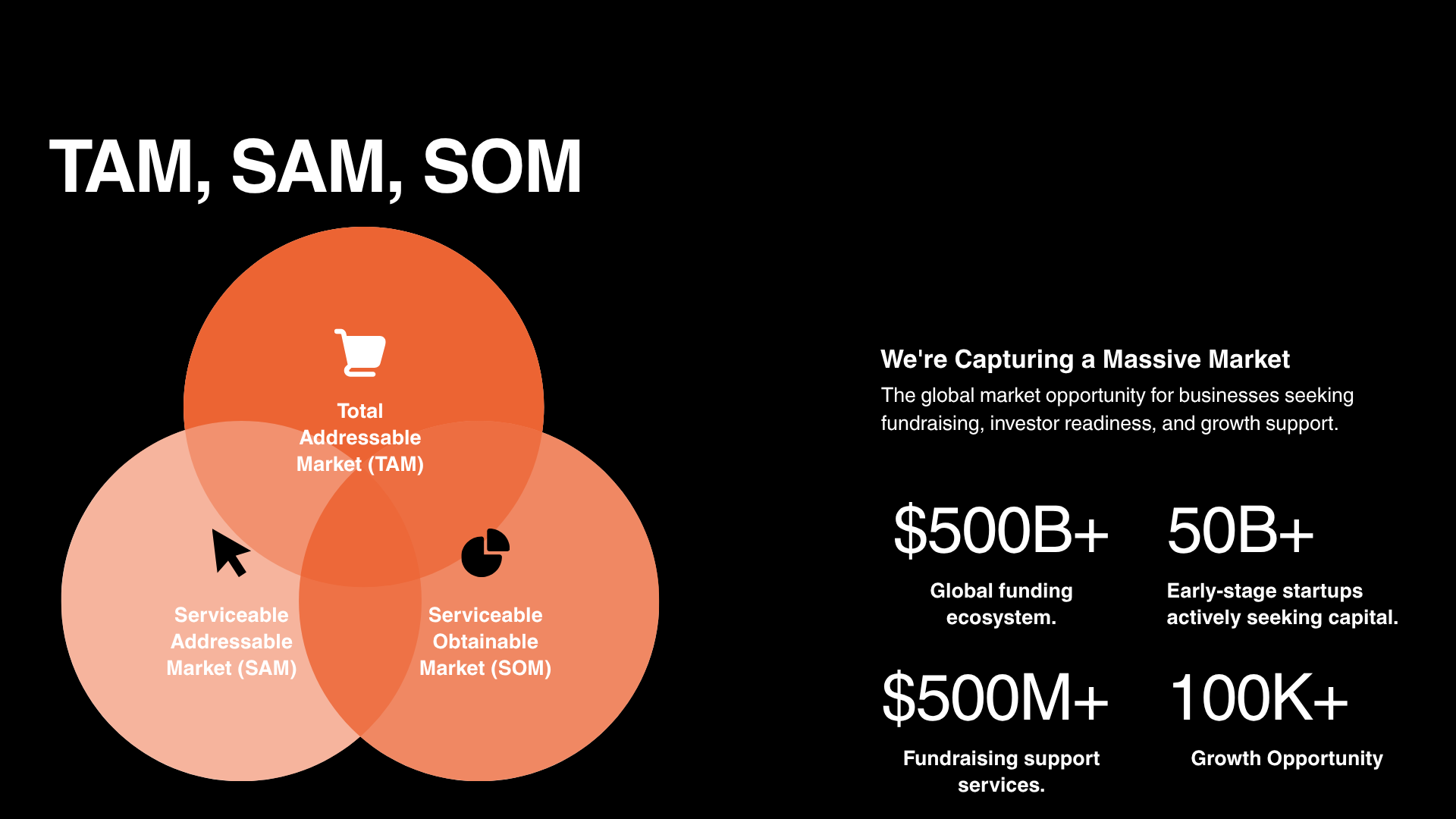
Get your TAM wrong — investors will reject you instantly.
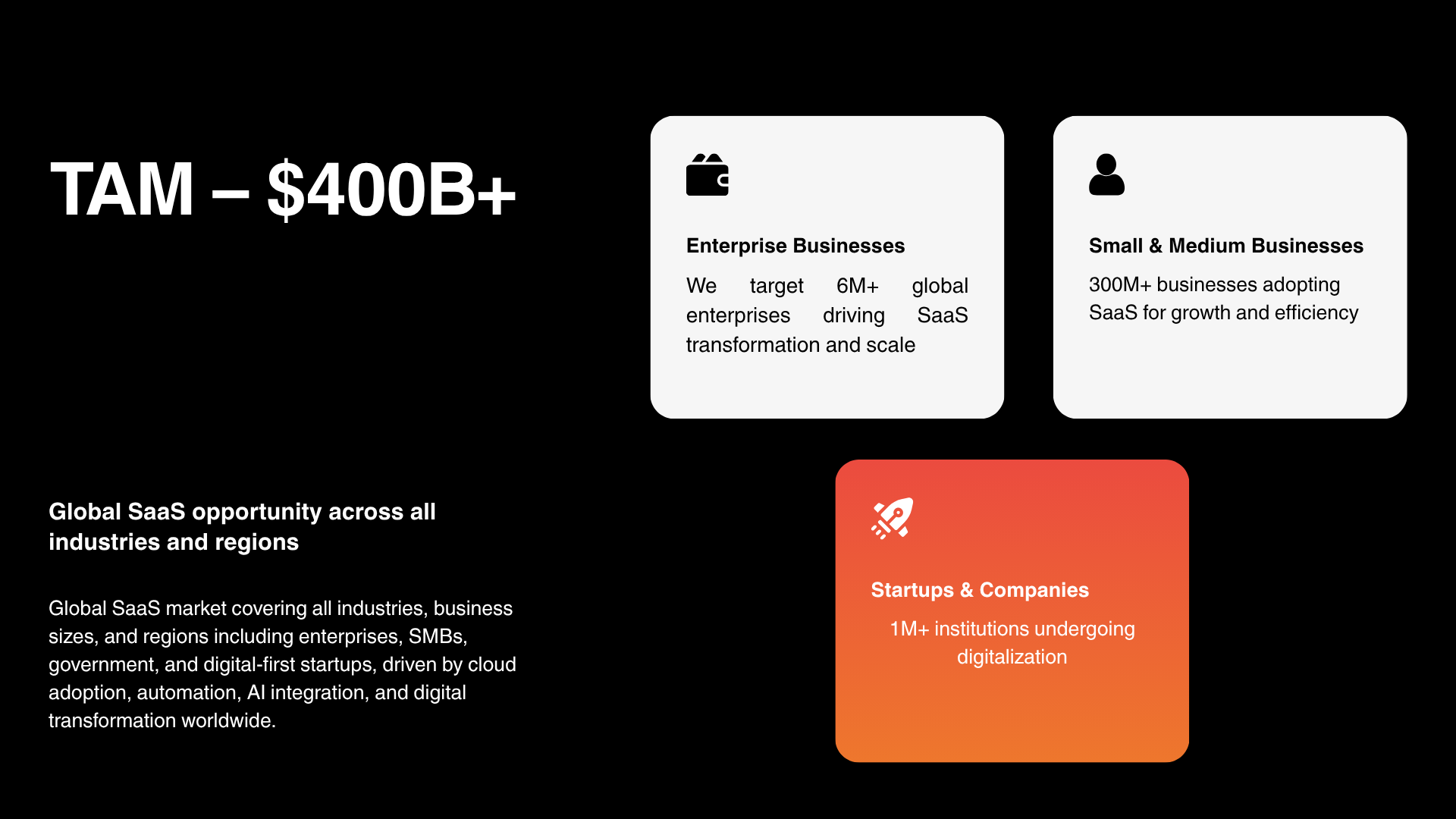
TAM —
Total Addressable Market
The entire global demand for your solution if every possible customer bought it.
VC question: “Is this market big enough to build a $1B company?”
Example: Global SaaS market = $400B
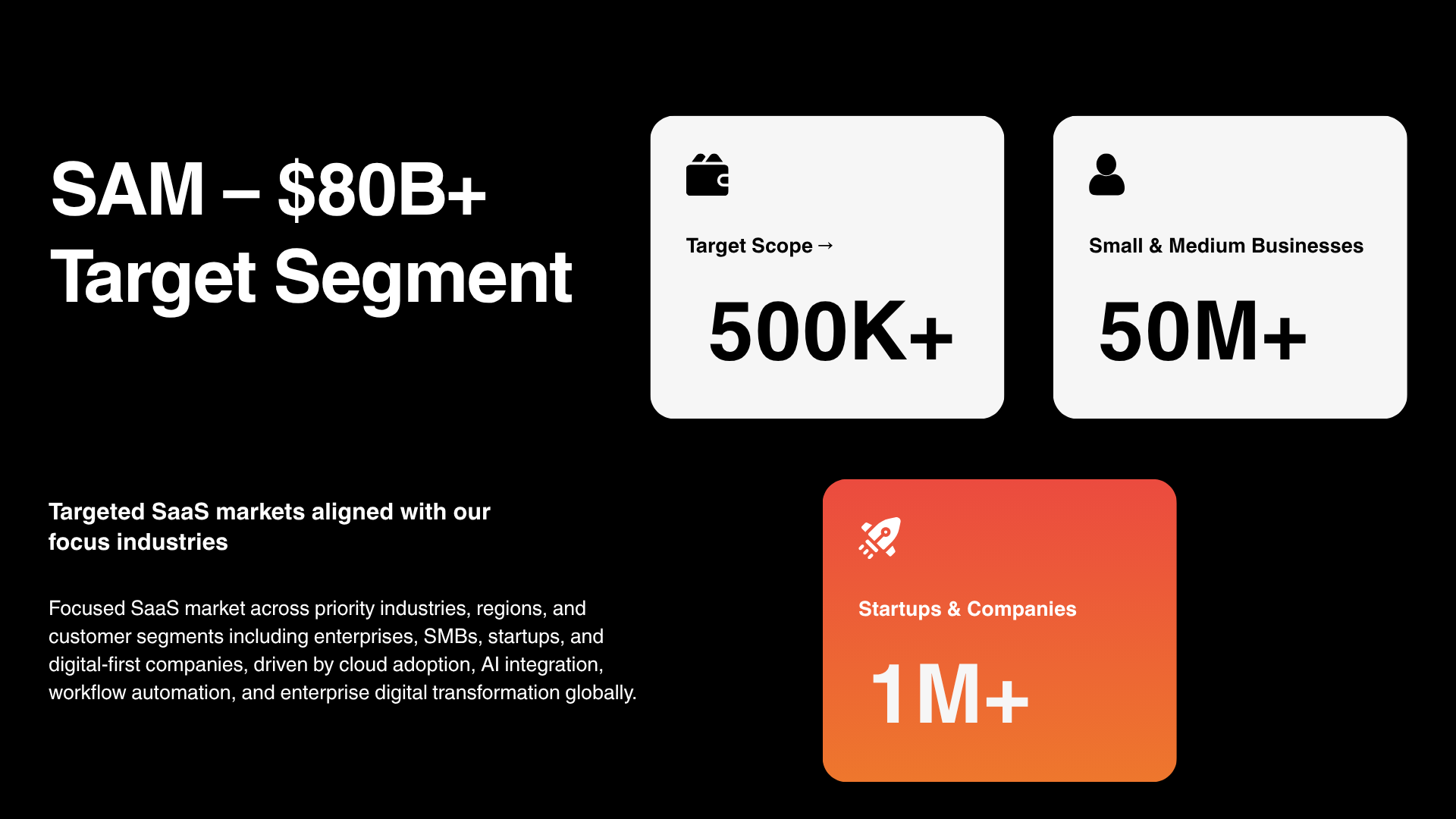
SAM —
Serviceable Addressable Market
The portion of TAM you can realistically reach with your product, geography and business model today.
VC question: “Can they actually serve this segment with what they’re building?”
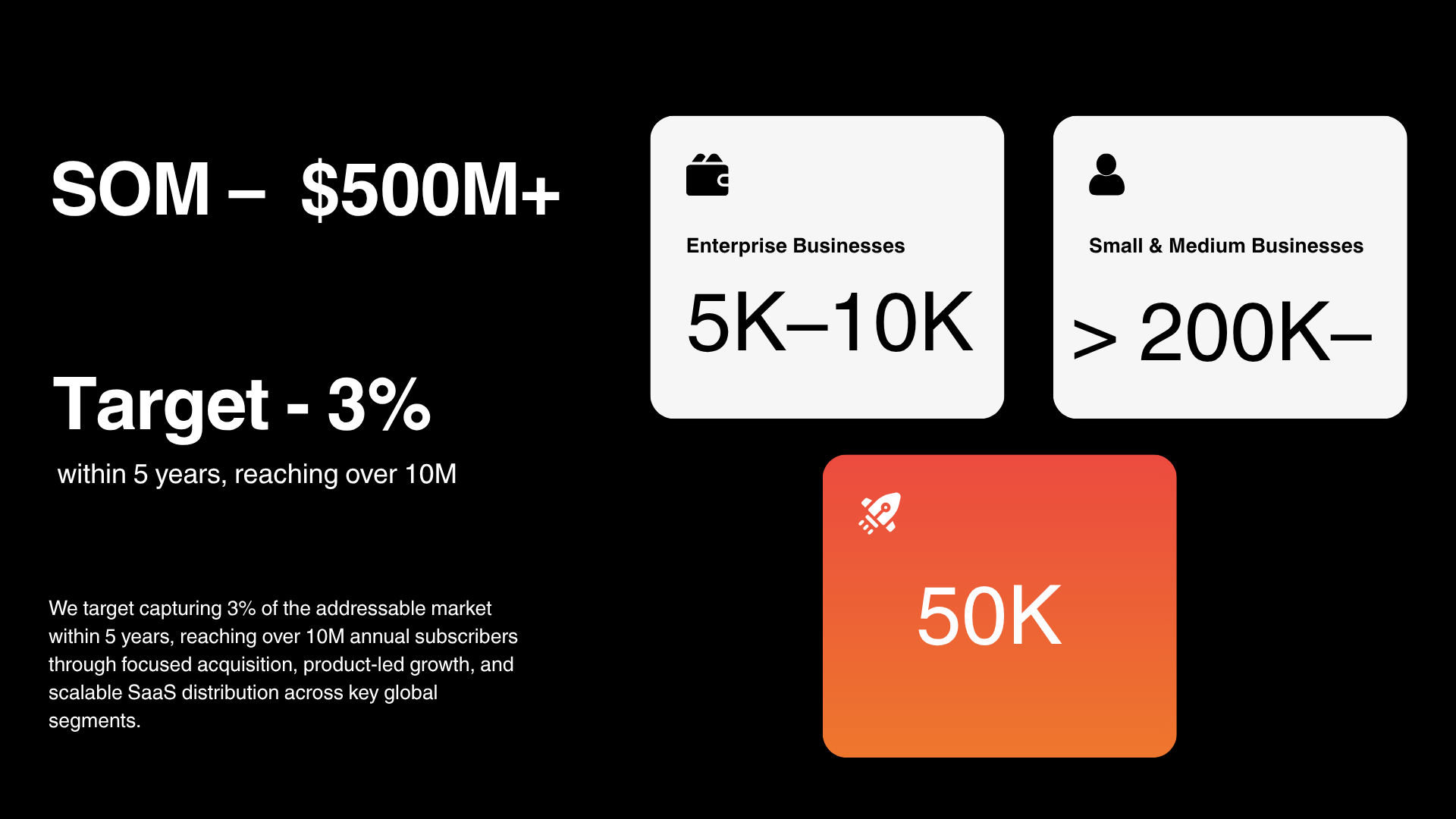
SOM —
Serviceable Obtainable Market
The realistic market share you can capture in the next 3–5 years given your resources and go-to-market.
VC question: “Is this growth target believable at their current stage?”
Example: 1–3% penetration in Year 3 = $500M–$1.5B
Why do most founders get TAM SAM SOM completely wrong?"
Blobal market is $500 billion." No segmentation. No logic. No credibility. VCs hear this 10 times a day — and pass every time.
No Source
We estimated based on industry trends." That's not research. That's a guess.
Disconnected SOM
Your SOM says $1B but your Year 3 revenue says $2M. VCs will catch it.
How do you define your GTM target market so investors actually believe your SAM?
TAM → SAM → SOM must always get smaller.
And SOM must always match your Year 3 revenue projection. Always.
Don't Google a number. Use Gartner, Statista, World Bank, or government reports. Show the source on the slide. One credible citation builds more trust than 10 slides of great design.
Ask yourself — who can I actually reach today? Filter by geography, language, business model, and budget. Show the narrowing logic clearly. VCs want to see your thinking, not just the number.
Ask yourself — who can I actually reach today? Filter by geography, language, business model, and budget. Show the narrowing logic clearly. VCs want to see your thinking, not just the number.
How Do You Pass?
The Source Check "Where did this number come from?"
First thing they look for. No source = instant doubt. Two credible sources = instant credibility.
Check 1 — The Logic Check
"Does TAM → SAM → SOM actually make sense?" They follow the narrowing. If any step feels like a jump — they'll call it out in the room.
Check 2 — The Competition Check
"If it's this big — why isn't it already taken?" Be ready to answer this. Address it on the slide before they ask.
Check 3 — The Timing Check
"Is this market growing or flat?" A big static market is not exciting. Show the CAGR — "Growing at 22% through 2028" is more powerful than any number.
Check 4 — The Financial Check
"Does SOM match their Year 3 revenue?" They open your financial model slide and cross-check. If it doesn't align — the meeting is effectively over.
FAQ: Fit Answers Quickly
TAM (Total Addressable Market) is the full global revenue opportunity. SAM (Serviceable Addressable Market) is the portion you can realistically target. SOM (Serviceable Obtainable Market) is what you can actually capture in the near term. Investors use this framework to judge ambition vs. realism — get any of the three wrong and they’ll question your market understanding entirely.
Use two approaches and show both. Top-down: cite a credible industry report (IBISWorld, Statista, Grand View Research) and define the segment your product serves. Bottom-up: multiply your average contract value by the total number of potential customers. Bottom-up is more trusted by investors — it shows you’ve done real math, not just cited a big number.
Citing a massive, undifferentiated market number with no logic behind it — what investors call “lazy TAM.” Saying “the global healthcare market is $8T” when you’re building a niche SaaS tool signals you don’t understand your actual customer. Always narrow your TAM to the specific problem, geography, and buyer persona you serve.
Most VCs want to see a TAM of at least $1B for a venture-scale business — because they need a 10x return and that requires a market large enough to support it. For seed rounds, $500M+ is often acceptable if your growth thesis is compelling. Below that, you’re likely better suited for angel investors or revenue-based financing.
SAM is your TAM filtered by your actual go-to-market constraints — geography, language, regulatory environment, distribution channel, and product fit. If your TAM is the global HR software market, your SAM might be mid-sized tech companies in English-speaking markets. Define it by your ICP (ideal customer profile), not by what sounds big.
Show your SOM as a bottoms-up projection tied to your sales capacity, marketing budget, and conversion benchmarks. A SOM of 1–5% of SAM in year 1–3 is credible. Back it with assumptions: number of sales reps, average deal cycles, and customer acquisition cost. Investors respect founders who show constraint — it signals execution intelligence, not lack of ambition.
Struggling to get your TAM, SAM & SOM right before investors do?
Everything you need to walk into any investor meeting fully prepared — pitch checks, financial model guide, due diligence checklist, outreach strategy, and 10 AI fundraising prompts, all in one free download.